Dr Robert Opoka
Advancing Medical Education to Transform Healthcare for Generations
 For Professor Robert Opoka, improving healthcare in East Africa has always begun in one place: the classroom. Not the traditional classroom of lectures and memorisation, but the kind that shapes how young doctors think, question, and ultimately save lives. Over the past two decades, he has become one of the region's most influential voices in medical education, helping shift entire systems toward stronger clinical training, modern assessment methods, and evidence-based learning.
Before joining the Aga Khan University, Dr Opoka spent more than 20 years at Makerere University in Uganda, where he quietly led a revolution in how future doctors are trained. At a time when clinical exams across the country relied heavily on subjective assessments, he championed the introduction of Objective Structured Clinical Examinations (OSCEs), ensuring fairness and consistency in how medical competencies were evaluated. What began as a bold change at Makerere is now implemented nationwide across all Ugandan universities, leaving a permanent mark on the training of thousands of clinicians.
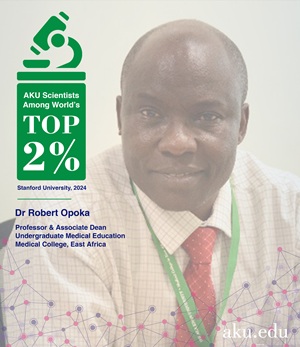
His commitment to building stronger medical education systems grew alongside a deep dedication to improving clinical outcomes for children. As a paediatrician and researcher, he has published over 130 peer-reviewed papers whose findings have helped shape care for some of the region's most vulnerable populations. His work has been cited widely—earning him a place on Stanford University's 2024 list of the Top 2% most-cited scientists worldwide, a recognition that reflects the real-world impact of his research across sub-Saharan Africa.
Dr Opoka's journey has been shaped by an unusually broad academic foundation. From Makerere to Guangxi University in China, to the University of California Berkeley, to Maastricht University in the Netherlands, and finally back home for a PhD in Health Sciences, he has built a rare combination of clinical, epidemiological and medical-education expertise. Yet it is his ability to translate this training into meaningful institutional change that defines his legacy.
At Makerere, he helped introduce a postgraduate medical education programme that expanded opportunities for young clinicians. He played a central role in problem-based learning reforms, coordinated paediatrics training, and strengthened acute care services at Mulago National Referral Hospital. Through Global Health Uganda, which he founded and led for over a decade, he created opportunities for research, training and international scientific collaboration.
In 2024, as AKU prepared to launch its historic Bachelor of Medicine, Bachelor of Surgery (MBChB) degree in East Africa, it became clear that Dr Opoka's experience was not only relevant, it was foundational. He joined AKU as Associate Dean for Undergraduate Medical Education, bringing with him an unwavering belief that the quality of healthcare depends first and foremost on the quality of medical training.
At AKU, he now leads efforts to implement a world-class undergraduate programme built on evidence-based teaching, cutting-edge technology, and the clinical excellence of the Aga Khan University Hospital in Nairobi. He envisions a generation of graduates capable of reshaping policy, elevating patient care, and influencing the direction of medical education across the region.
Beyond academics, Dr Opoka's story includes unexpected chapters: a childhood dream of becoming a priest, formative years spent mastering football to national-junior level, and a lifelong love for Manchester United. But whether on the field or in the classroom, his approach has always been the same: discipline, purpose, and a belief that the next generation deserves better than the last.
Today, Professor Opoka stands as one of East Africa's most impactful medical educators and researchers. His work ensures that long after he leaves the classroom, his influence will continue—in every patient treated by the doctors he helped train.