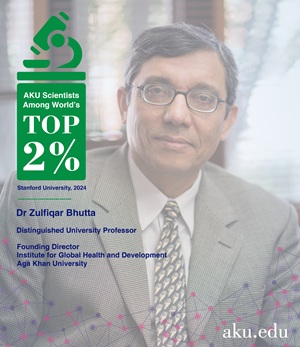
Dr Zulfiqar Ahmed Bhutta
Turning evidence into equity for mothers and children worldwide
 For more than three decades, Dr Zulfiqar Ahmed Bhutta's work has shaped how the world understands and acts on the health needs of mothers and children living in the most vulnerable settings. From rural communities in South Asia to global policy tables at the World Health Organisation and the United Nations, his research has consistently translated evidence into action, influencing how care is delivered where it matters most.
At the Aga Khan University, Dr Bhutta's leadership has helped establish globally influential platforms for research, policy, and capacity building. As Founding Director of the Centre of Excellence in Women and Child Health and the Institute for Global Health and Development, he has built bridges between rigorous science and real-world implementation. His unique joint appointments with The Hospital for Sick Children and the University of Toronto have enabled cross-continental collaboration, ensuring that insights generated in low- and middle-income countries inform global health agendas and vice versa.
What distinguishes Dr Bhutta's work is its unrelenting focus on equity and access for marginalised populations. His research on newborn and child survival, maternal and child undernutrition, and micronutrient deficiencies has reshaped international guidelines and national policies alike. These efforts have strengthened community-based primary care models, empowered frontline health workers, and improved outcomes for millions of children and families who might otherwise have been left behind. Policymakers, clinicians, and educators across continents have drawn on his work to design interventions grounded in local realities but scalable at national and global levels. He was appointed to an independent expert review group (2010-2015) by the UN Secretary General to monitor global progress in maternal, newborn and child health covering the millennium development goal period.
Recognition has followed impact. Dr Bhutta has been consistently named among Stanford University's Top 2% most-cited scientists globally since the database was established in 2019, a reflection of the reach and relevance of his scholarship. Over the years, his contributions have been acknowledged through some of the world's most prestigious honours in global health, including national and international awards that recognise not just academic excellence, but measurable improvements in population health and impact.
Beyond research and policy, Dr Bhutta has played a defining role in shaping institutions and ethical frameworks. As the Founding Chair of Pakistan's National Research Ethics Committee (2003-14), the Health and Allied Sciences Panels at the Higher Education Commission (2002-10 and 2019-2024) and a long-serving leader within professional and regulatory bodies, he has helped strengthen the governance structures that underpin credible, responsible science. His advisory roles with governments, multilateral agencies, and global alliances have ensured that evidence remains central to decision-making, even in complex humanitarian and fragile settings.
Equally important is his commitment to mentorship and institution-building. Dr Bhutta has invested in developing the next generation of scientists and health leaders, embedding research capacity within systems that will outlast any single career. His influence can be seen not only in publications and policies, but in the global network of researchers and practitioners carrying forward his approach to community-centred, evidence-based health.
Professor Zulfiqar Bhutta's career stands as a reminder that the most powerful science is science in service to children, families, and communities whose lives depend on evidence translated into action.