Dr Zafar Fatmi
Researching Solutions for a Changing World
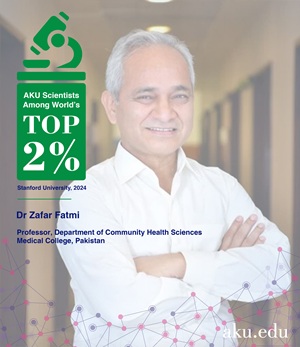 For Pakistan and other climate-vulnerable countries, rising temperatures, worsening air quality, and shifting climate patterns are no longer distant risks. They are daily realities that place growing strain on health systems and livelihoods.
This is where the work of Professor Zafar Fatmi holds particular importance. Early in his career, Dr Fatmi was drawn to environmental health research as the effects of climate change became increasingly visible and its consequences for human health more urgent.
Today, Dr Fatmi serves as Professor and Section Head of Environmental, Occupational Health and Climate Change at the Department of Community Health Sciences, Aga Khan University (AKU). An internationally recognised researcher and committed academic, Dr Fatmi has advanced environmental health research, influenced local practise and policy, and mentored future scientists.
Speaking about his approach, Dr Fatmi explains, “Research must not only uncover problems, but also help us design solutions that are local, sustainable, and equitable. In Pakistan, tackling environmental health challenges like air pollution and climate change is not just scientific work. It is a pathway to improve lives, especially for the most vulnerable."
His research spans environmental health, occupational health, climate change and health, injury epidemiology, and public health policy and burden assessment. Together, these areas reflect a sustained focus on understanding how environmental exposures shape everyday life. With over 150 published articles, along with book chapters, reviews, and other scholarly contributions, Dr Fatmi has earned recognition among the top two per cent of the world's most-cited researchers, according to a well-known study conducted at Stanford University.
Among his most influential contributions is his research on the health impacts of biomass fuel use. In one study, Dr Fatmi and his colleagues found that the use of biomass fuels for cooking was strongly associated with acute coronary syndrome among women in rural Pakistan. He has also contributed to policy-relevant research, including a situational analysis of household energy use and the health burden of indoor air pollution in Pakistan, as well as national-level estimates of unintentional injuries among children under five and adults, based on data from the National Health Survey.
Dr Fatmi has also helped build institutional capacity for environmental health research at AKU. He has developed graduate-level modules in climate change and environmental health for both undergraduate and postgraduate programmes, and currently supervises FCPS (Community Medicine), MSc (Epidemiology and Biostatistics, Health Policy and Management), and PhD students. Looking ahead, Dr Fatmi's long-term ambition is to establish a knowledge-management centre on sustainability topics at AKU.
In addition to his work at AKU, Dr Fatmi collaborates widely with universities and institutions in the United States, the United Kingdom, Japan, and Saudi Arabia. He currently also serves as a member of the World Health Organization's Global Platform on Air Quality and Health.
At a personal level, Dr Fatmi continues to be inspired by the scale of local public health challenges and the potential for change, noting, “the scale of the challenges is so large that anything you do would have a very high impact on improving the lives of people."
His work holds particular relevance for Pakistan, a country already grappling with the effects of climate change. His ongoing research includes studying how climate variables influence air pollution in major cities such as Karachi and Lahore, examining heat exposure among outdoor workers and potential adaptive strategies, and contributing to doctoral research on pathogen-environment interactions, including vector-borne disease modelling.