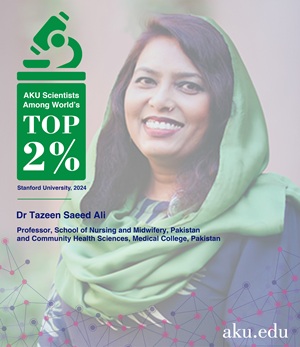
Dr Tazeen Saeed Ali
Turning Research into Safer, Healthier Futures
 On a warm afternoon in her first year of university, Dr Tazeen Saeed Ali noticed something peculiar: some classmates nursed pounding migraines after a cup of tea or coffee, while others felt nothing at all. It was a small curiosity, almost forgettable, but it lit a spark into research that would grow into a lifelong pursuit: understanding why health outcomes differ, and how research can help close those gaps.
Over the decades since, that spark has become a steady, guiding light. Today, Dr Ali stands among the world's top 2% most-cited scientists according to Stanford University, her work is shaping policies, transforming nursing education, and protecting communities in need across Pakistan. But her motivation has never been prestige. “I have always wanted to improve the health and well-being of women and vulnerable populations," she says. “Witnessing inequities in health care access and outcomes motivated me to generate research that can lead to real-world change."
As a professor and former Interim Dean at AKU's School of Nursing and Midwifery in Pakistan, Dr Ali helped elevate this vital profession. Her impact is visible in strengthened nursing curricula, improved leadership pathways, and competency-based education for undergraduate and graduate nursing programmes.
Long before her first peer-reviewed article appeared in 2001, Dr Ali was already finding new and better ways to aid the community. In her early years, she wrote for the Urdu Aman newspaper, weaving practical guidance on hygiene and disease prevention for families who might never open a medical journal. Through the Munni Baji radio programme, she transformed research findings into simple messages that listeners across Pakistan could carry into their daily lives. Those experiences cemented her belief that “research is unfinished until it is shared."
In the years since, Dr Ali's research has grown to include more than 250 publications and over 4,000 citations, each one marking a steady commitment to advancing equity. Her work spans some of the most difficult and vital terrains in Pakistan: gender-based violence, reproductive rights, migrant and community health, child sexual abuse, and other issues that profoundly affect the lives of vulnerable groups.
Her findings have since been pressed into policies and laws, slowly reshaping them in Pakistan. They contributed to raising the legal age of marriage and strengthening protections against domestic violence. Her work also supported efforts to place the safety and dignity of women at the centre of public health and legal reform.
Alongside research and health system reform, mentorship sits at the heart of her work. As a mentor and consultant, she has guided faculty, postgraduate scholars and new researchers with steadiness and purpose. “Investing in research, education, and mentorship ensures that we can create lasting, meaningful impact in our communities," she says. “I am proud to see many of my mentees in leadership and academic roles."
Recognition has followed Dr Ali in many forms, from awards and peer respect to inclusion in influential boards and organisations. But she has always measured success in quieter ways — in healthier communities, safer homes, stronger protections, and students who continue the work with the same flame she once lit in her first year.