Dr Sameen Siddiqi
Designing health systems that work—where equity, evidence, and impact meet
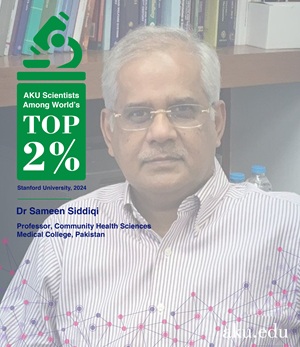 Through three decades of service in some of the world's most complex health systems, Professor Sameen Siddiqi has helped shape how countries think about equity, access, and the architecture of care. From Pakistan to the Eastern Mediterranean Region, his work has focused on a central question: how can health systems be designed to work for those who need them most?
As Professor and former Chair of the Department of Community Health Sciences at Aga Khan University, Dr Siddiqi has positioned evidence as the bridge between research and policy. Under his leadership, the University has strengthened its role in informing national and provincial health reforms, particularly in advancing universal health coverage. This commitment to translating research into action is reflected in initiatives such as the Primary Health Care Learning Agenda, a two-year, Gates Foundation–supported programme that convenes governments, researchers, and development partners to generate practical insights for strengthening primary health care across Pakistan.
Dr Siddiqi's influence extends well beyond academia. During sixteen years with the World Health Organisation, including as Director of Health System Development at the WHO Regional Office for the Eastern Mediterranean, he spearheaded regional efforts on universal health coverage and health system reform. As WHO Representative to Lebanon and Iran, he worked in fragile and resource-constrained settings, reinforcing his conviction that resilient health systems depend on strong governance, quality of care, and effective public–private engagement.
Central to Dr Siddiqi's impact is his ability to navigate complexity while keeping people at the centre. His work on integrating private sector provision, improving service quality, and strengthening financing mechanisms reflects a pragmatic approach to reform that recognises the realities of mixed health systems in low- and middle-income countries. At the national level, this perspective has informed policy dialogue, technical assistance, and strategic reviews, including his role as co-chair of Pakistan's National Advisory Committee on Health. In this capacity, he has contributed to enhancing the impact of priority public health programmes. Most recently, he led the development of Pakistan's new Health and Population Policy (2026–2035), which has recently been approved by the Inter-Ministerial Health and Population Council.
Dr Siddiqi has also shaped global thinking through scholarship grounded in practical application. As lead editor of Making Health Systems Work in Low- and Middle-Income Countries, published by Cambridge University Press, he helped produce a resource that explicitly addresses the “how" of health system strengthening. His extensive publications, alongside service on international committees and editorial boards, underscore his role as both a thought leader and system builder. He currently serves on two Lancet Commissions: Primary Health Care in the Post-COVID Era and Health System Performance Assessment.
In 2024, his sustained influence was recognised with inclusion in Stanford University's list of the world's top two percent most-cited scientists. For Professor Siddiqi, however, impact is measured less by citations than by systems strengthened and policies informed. Working closely with the Department of Health Sindh, he is leading a large pilot to implement an Essential Package of Health Services in Tando Allah Yar, covering one million people. Designed for scale-up, the initiative reflects a career dedicated to evidence-driven leadership and more equitable health care for populations too often left behind.