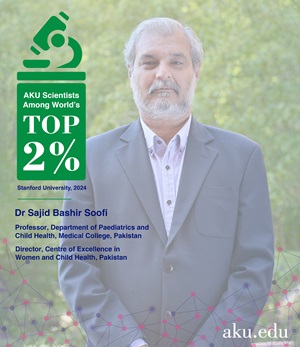
Dr Sajid Bashir Soofi
Protecting Childhood Through Research
 A child's first few years of life can determine everything that follows — whether they grow well, whether they are able to learn and thrive, and whether they go on to live a healthy adulthood.
For more than two decades, Professor Sajid Bashir Soofi has focused his work on strengthening those earliest foundations. An Abdul Sultan Jamal Endowed Professor in the Department of Paediatrics and Child Health at the Aga Khan University (AKU), he began his journey as a paediatric resident at AKU and has continued to work at the intersection of clinical care, policy development, and public health research ever since.
Dr Soofi's research centres on maternal, newborn, child, and adolescent health, with a particular emphasis on nutrition, infectious diseases, and vaccine-preventable illnesses. These are among the most persistent threats to child survival in many low- and middle-income countries. His work spans both health facilities and communities, allowing him to see not only the individual child who needs care, but also the larger systems that determine whether children receive timely vaccinations, adequate nutrition, and essential health services. Much of his findings emphasise the integration of newborn, child, and nutrition interventions into existing health system programmes.
Over the years, he has spearheaded multiple high-impact clinical trials and large-scale national and international population-based surveys and program evaluations. He served as a co-investigator for the National Nutrition Surveys in Pakistan (2011 and 2018), as well as for surveys conducted in the Maldives, Sri Lanka, Afghanistan, and Eritrea. He led Pakistan's first-ever largest district-specific Immunization Coverage Survey (The Third-Party Verification Immunization Coverage Survey - TPVICS) and supported polio programmes in Pakistan and Afghanistan by generating evidence to review and improve polio eradication strategies.
Dr Soofi's work has helped provide governments and global agencies with the data needed to identify gaps, allocate resources, and strengthen health programmes. Evidence from this work has helped guide policies targeting maternal and child survival and integrate newborn, child, and nutrition interventions into existing health system programmes rather than delivering them in isolation. This approach increases the likelihood that successful interventions can be sustained and scaled, reaching more children over time.
With more than 265 publications in peer-reviewed journals including The Lancet, The Lancet Global Health, The Lancet Infectious Diseases, the Journal of Infection and Public Health, the American Journal of Clinical Nutrition, and JAMA Network Open and over 9,569 citations, Dr Soofi has earned a place among the world's top two percent of most-cited scientists according to a well-known study by Stanford University.
As Principal Investigator, he has secured more than 70 competitive research grants with a combined value exceeding USD 65 million and has partnered with globally renowned organisations such as the World Bank, Bill & Melinda Gates Foundation, World Health Organization, UNICEF, Gavi-the Vaccine Alliance, World Food Programme, CDC Foundation, Harvard University, University of British Columbia, University of Sydney, University of Edinburgh, University of Birmingham, and The Hospital for Sick Children.
His contributions have been recognised internationally, including through the International Health Research Award from the American Academy of Paediatrics (2010), the Outstanding Research Faculty award by Aga Khan University (2017 & 2021), the Research Paper of the Year 2017: at the British Medical Journal Awards South Asia, the Charles C. Shepard Science Award from the Centres for Disease Control and Prevention, USA (2019), and the Aga Khan University Award for Excellence in Research (2023).
These achievements not only reflect trust in the quality of the evidence generated but also its relevance to real-world health challenges. By improving how countries prevent and manage illness in early childhood, Dr Soofi's work helps protect children today while strengthening health systems for future generations.