Dr Romaina Iqbal
Research That Starts and Ends with Communities
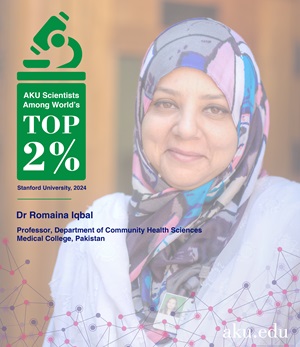 For Dr Romaina Iqbal, research is ultimately about people: their lives, their environments, and the choices available to them. As a Professor in the Department of Community Health Sciences at Aga Khan University, Pakistan, she leads the Non-Communicable Diseases (NCD) and Mental Health section, focusing on health challenges affecting millions across the country.
At the heart of her work is a commitment to engaging communities as active partners in research. Rather than imposing solutions, Dr Iqbal shapes interventions according to local realities and priorities. Across her projects, communities help identify problems and develop solutions, supported by coalitions that bring together academic institutions, policymakers, and community stakeholders.
A distinguished researcher with over 180 publications, Dr Iqbal's work focuses on preventing disease by tackling common risk factors, including unhealthy diets, physical inactivity, tobacco use, air pollution, and the built environment, with particular attention to adolescents and school-going children. “If we want to prevent non-communicable diseases," she says, “we need to act early—especially in schools and communities, where habits are formed."
Supported by competitive grants, her research demonstrates this principle in action. It spans initiatives such as sugar-sweetened beverage labelling for schoolchildren, school health programmes, population-level assessment of salt intake, efforts to make universities smoke-free, and maternal health interventions targeting gestational diabetes mellitus.
Dr Iqbal's research prowess has earned her national and international recognition. She was ranked among the world's top 2% most-cited researchers in 2024, according to a Stanford University study. In Pakistan, she was named among the top 10 most prolific health scientists in 2017 by the Pakistan Council of Science and Technology.
Alongside her research, Dr Iqbal has worked consistently to strengthen health systems and professional capacity. She has led task forces and training workshops for nutritionists and other health professionals and, as Vice President of the Pakistan Nutrition and Dietetic Society (PNDS) from 2022 to 2023, advocated for the growth and recognition of the nutrition profession in Pakistan.
Mentorship is also central to her impact. Dr Iqbal has supervised around 40 graduate and PhD students at AKU and beyond, many of whom now contribute to academia, research organizations, and public health programmes, extending the impact of her work.
Through her leadership, contributions and advocacy, Dr Iqbal is helping to reduce Pakistan's staggering burden of disease, free up critical health resources, equip communities with the knowledge and habits to safeguard their health, and give future generations a healthier start to life.