Dr Mansoor Saleh
Driving a New Era of Translational Cancer Research and Equity in Africa
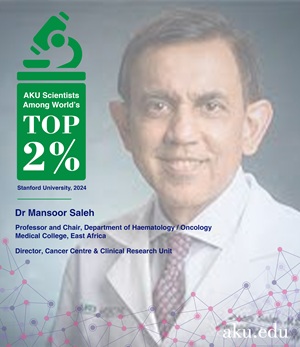 For more than four decades, Professor Mansoor Saleh has dedicated his career to advancing one of the most urgent challenges in global health: ensuring that cancer research serves all populations, especially those historically left behind. His inclusion in Stanford University's 2024 list of the World's Top 2% most-cited scientists reflects not just academic productivity, but the profound global impact of his work.
He received his medical education at the University of Heidelberg and conducted his research at the renowned Max Planck Institute for Medical Research in Heidelberg where he acquired a keen interest in targeted therapy of cancer. In the United States, Professor Saleh's scientific journey has always been shaped by his roots in East Africa and in the Aga Khan Schools system. Working at the forefront of early-phase clinical trials at the University of Alabama at the Birmingham Comprehensive Cancer Center, he helped bring promising new cancer therapies from the laboratory bench to the bedside, contributing to treatments that are now saving lives around the world. But his success also revealed a troubling reality: the discoveries transforming cancer care were based almost entirely on data from Western populations, leaving African patients—who carry some of the world's highest cancer burdens—largely unrepresented.
This gap was not simply scientific; it was deeply inequitable. Africa is home to extraordinary genetic diversity, yet less than two per cent of global clinical trial participants come from the continent. Without meaningful representation, even the most advanced therapies cannot fully account for the biological, environmental, and genomic factors that influence how cancers develop and respond to treatment in African populations. For Professor Saleh, this omission carried moral weight. If science was to serve all humanity, Africa could not remain on the margins of discovery.
With this conviction, and inspired by AKU's Founding Chancellor, His Highness Aga Khan IV's statement made at the inauguration of the Heart and Cancer Center in 2011: “Let me mention two investment areas most sadly short changed in the developing world – research and education…", he made the pivotal decision to return to East Africa in 2020 to help build the region's capacity for high-quality, GCP-compliant cancer research and educate the next generation of African oncologists. As the Founding Director of the Cancer Centre and Clinical Research Unit at AKU in Nairobi, he set out to demonstrate, not in theory but in practice, that clinical trials meeting the highest global standards could thrive in the region.
Under his leadership, AKU's Cancer Centre has rapidly emerged as one of East Africa's leading hubs for oncology research. His efforts have enabled patients to access innovative therapies years earlier than before, strengthened regulatory partnerships, and inspired greater investment from global research collaborators who now recognise the scientific excellence possible in Kenya.
What distinguishes Professor Saleh's contribution is not only his scientific expertise but his determination to transform systems. He has championed capacity-building for young East African investigators, established collaborative research networks, and advocated for stronger national research frameworks, all essential for creating a sustainable, African-led research ecosystem. His work is paving the way for a future in which African patients are not merely recipients of treatments developed elsewhere, but active participants whose data, experiences, and needs shape global cancer innovation.
Despite decades of international recognition, Professor Saleh remains grounded in the values of integrity, gratitude, and service instilled in him early in life. His leadership reflects a belief that excellence has no geographic boundaries and that Africa has a critical role to play in the future of cancer care.
Today, as East Africa's research landscape grows in sophistication and influence, Professor Mansoor Saleh stands at the centre of a transformation—one that is not only expanding scientific knowledge, but advancing equity, access, and hope for millions of patients across the continent.