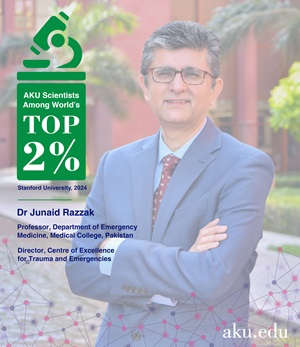
Dr Junaid Razzak
Turning critical minutes into lifesaving systems
 When seconds determine survival, systems matter as much as skill. For more than two decades, Professor Junaid Razzak has worked at that decisive intersection: where emergency medicine, public health, and technology converge to save lives that would otherwise be lost to delay, fragmentation, or lack of access. His career has been shaped by a single, persistent question: how can emergency care reach people faster, more equitably, and with greater impact, particularly in settings where resources are limited but need is immense?
Trained at AKU, Yale University, and the Karolinska Institute, Dr Razzak returned to Pakistan with a conviction that emergency care could no longer be treated as an afterthought in health systems. At AKU, he went on to establish the country's first academic department of emergency medicine and direct its inaugural residency programme thereby laying the foundation for a specialty that now spans institutions across Pakistan. What began as a single residency programme evolved into a national movement, reshaping how emergency care is delivered, taught, and studied in the country.
Yet Dr Razzak's impact extends far beyond institutional milestones. His research has consistently focused on the moments before patients reach a hospital: the period when lives are most vulnerable. From studying why critically ill children were dying in ambulances to piloting ambulance-based telemedicine that connects paramedics with physicians in real time, his work has addressed gaps that conventional health systems often overlook. These innovations have relevance not only for low- and middle-income countries but also for rural and underserved settings globally, where distance and delay remain formidable barriers to survival.
Central to this vision is the Pakistan Life Savers Programme (PLSP), a nationwide initiative spearheaded by Dr Razzak through the Aga Khan University's Centre of Excellence for Trauma and Emergencies. Built on partnerships across academia, government, and civil society, PLSP aims to train 10 million citizens in basic life-saving skills such as CPR and bleeding control. The premise is simple yet transformative: by empowering bystanders to act in the first critical minutes after cardiac arrest or trauma, even a small reduction in preventable deaths could translate into lives saved every single day. In a country where formal emergency response systems cannot always reach in time, PLSP reframes ordinary citizens as the first link in the chain of survival.
Dr Razzak's scholarship, spanning emergency care, public health, informatics, and health technology, has informed policy, shaped clinical practice, and influenced global thinking on emergency systems. Recognised among Stanford University's Top 2% most cited scientists in 2024, his work reflects both academic rigor and practical relevance. Whether advising on integrated emergency care systems, leading global collaborations, or testing low-cost technologies designed for ambulances rather than ICUs, his focus remains consistent: solutions must work where the burden is greatest.
Across continents and contexts, Dr Razzak has demonstrated that emergency care is not merely about responding to crises - it is about designing systems that anticipate them. In doing so, he has helped redefine emergency medicine as a cornerstone of equitable health systems, proving that with the right evidence, partnerships, and vision, lives can be saved long before they reach a hospital door.