Dr Muhammad Imran Nisar
Turning Research into Real-World Change
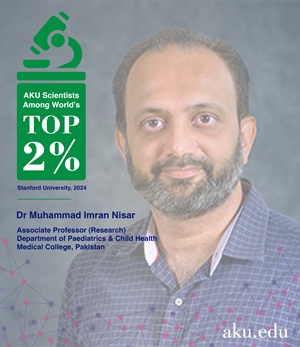 Across the developing world, the health of current and future generations often hinges on timely, accurate, and locally relevant evidence. Few embody this truth better than Dr Muhammad Imran Nisar, a global health researcher whose work sits at the crossroads of maternal and child health, infectious diseases, genomics, epidemiology, and public health surveillance.
For more than 15 years at the Aga Khan University (AKU), he has built systems, led teams, and produced evidence that has transformed public health policy and practice in Asia, Africa, and beyond, ultimately protecting countless lives.
Dr Nisar had the distinction of being the first graduate of AKU's PhD in Population and Public Health (2021) and has rapidly risen through the ranks to become Vice Chair of Research in the Department of Paediatrics and Child Health. His driving purpose is simple yet profound: to ensure science tangibly improves the lives of mothers, newborns and children, particularly in settings where health systems struggle to reach the most vulnerable.
A hallmark of Dr Nisar's career is the sheer impact of his research. With over 170 peer-reviewed publications in leading journals such as The New England Journal of Medicine, The Lancet, and BMJ Global Health, and USD 20 million in competitive research funding, his work has been cited more than 56,000 times, placing him among the world's top 2% most-cited researchers according to Stanford University. This combination of productivity, influence, and recognition underscores a rare ability to translate evidence into solutions that matter.
Take his work on pneumococcal disease, for example— a bacterium that is a leading cause of pneumonia, meningitis, and other serious infections. Dr Nisar's research produced Pakistan's most detailed evidence on circulating strains, vaccine effectiveness, and evolving antibiotic resistance, directly shaping the country's national immunisation policy while contributing global discussions on next-generation vaccines. His team also leads Pakistan's participation in the Global Pneumococcal Sequencing Project 2.0, generating critical data that helps protect populations worldwide against emerging strains.
During the COVID-19 pandemic, he spearheaded innovative surveillance initiatives, including Pakistan's first wastewater-based monitoring programme. This system detected viral trends days or weeks before clinical cases rose, providing early warning that ultimately helped save lives. The programme's success informed World Health Organization guidelines and positioned AKU as a regional leader in environmental surveillance.
Dr Nisar's contributions in maternal and neonatal health have been enormous. Through the Alliance for Maternal and Newborn Health Improvement (AMANHI) Study, he established Pakistan's first population-based pregnancy biobank, enabling research on preterm birth, maternal anaemia, and newborn vulnerability across multiple countries. As a key investigator in multi-country consortia such as MIRNA, PRISMA, GSED 2.0, and ReMAPP, he has driven evidence that shapes maternal immunization strategies, neonatal infection guidelines, and early childhood interventions worldwide.
“Innovation is not a luxury—it is a necessity for places where every data point can translate into lives saved," he reflects. “I hope to keep building systems, people, and evidence that help countries like Pakistan make informed, equitable decisions for mothers and children."
As a mentor and educator for upcoming public health professionals, Dr Nisar's service is truly inspiring. He has helped establish sustainable research platforms; trained over 60 residents, fellows, and junior faculty, many now leading their own studies; and modernised infectious disease academia. Through his leadership, AKU has strengthened Pakistan's scientific capacity while contributing to global health security.