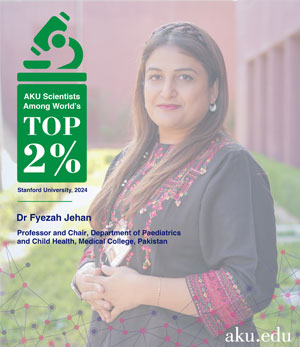
Dr Fyezah Jehan
Advancing the science that protects mothers and gives newborns a stronger start to life.
What if the most powerful way to save newborn lives was not a single silver-bullet intervention, but an intricate system designed to ask better questions—at scale, right in the communities where the stakes are highest?
For Professor Fyezah Jehan, this idea has not just shaped a career; it has built a global movement. Over more than a decade at the Aga Khan University, she has transformed the fight for maternal and newborn health in Pakistan, moving it from fragmented evidence to integrated, precision-driven solutions.
Dr Jehan's work is the intersection of epidemiology, infectious diseases, nutrition, and cutting-edge multiomics. Her mission is to translate high-level biological discovery into tangible solutions for the families facing the greatest burden of illness. Her work is grounded in vast, real-world data generated through large-scale, community-based clinical platforms like AMANHI, MOMI, and MUMTA. These aren't just studies – they are long-term scientific infrastructure that feeds directly into policy, national guidelines, and clinical care.
A true turning point came with the AMANHI biobank, established with the WHO and partners across South Asia and sub-Saharan Africa. By creating the first population-level, in-country pregnancy and newborn biorepository, Dr Jehan and her team pulled back the curtain on the fundamental biological pathways underlying preterm birth and devastating neonatal outcomes. For the first time, researchers had the biological samples needed to understand why these tragedies happen.
Through the MUMTA trials, her team demonstrated how carefully targeted inflammatory modulation can dramatically enhance nutritional interventions during pregnancy and early life. These breakthrough findings are now fueling new trials testing live biotherapeutics, probiotics, and novel supplements – a true path from molecular insight to a child's health.
In parallel, her work on paediatric infectious diseases has completely redefined care pathways for young infants. She led the largest antibiotic trial ever conducted for childhood pneumonia and contributed pivotal evidence on possible serious bacterial infection (PSBI). Her findings shaped national and global guidance on how newborns can be safely managed at the primary-care level, giving healthcare workers the tools they need to save lives in resource-limited settings.
When the COVID-19 pandemic swept the globe, Dr Jehan played a key role in developing national guidelines in Pakistan and contributed to WHO frameworks on infant feeding and mother-infant contact, ensuring science guided care in a fog of uncertainty.
Simultaneously, she was building the scientific infrastructure that will secure the future. By establishing advanced shotgun metagenomic sequencing and bioinformatics capacity at AKU, she created a regional hub for Gates-funded research and global consortia. This platform now enables high-resolution discovery across South Asia and Africa, ensuring the next generation of solutions will be regionally informed.
As Chair of the Department of Paediatrics and Child Health, she also oversees six paediatric fellowship programmes, cultivating an environment where research, clinical care, and teaching are woven together. Dr Jehan's mentorship philosophy has been credited with cultivating an environment rich in research opportunities, forging a new generation of scientists equipped to continue this life-saving work.
With over USD 24 million in extramural funding and more than 150 publications that have directly shaped national and WHO guidelines, Professor Jehan's work has successfully moved maternal and newborn health from descriptive epidemiology toward precision, prediction, and prevention.
Looking ahead, her vision is clear: to integrate artificial intelligence and predictive analytics into research to identify risk earlier and deliver better care exactly where it is needed most.