Protecting Lives Across Generations
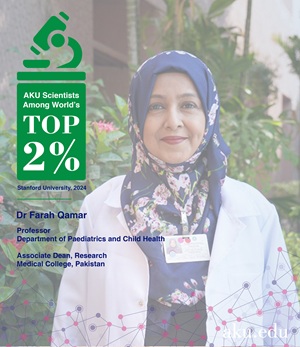 “Knowing that our work can prevent a child's death, reduce a mother's fear, or strengthen a community's health is what keeps me committed every day," says Dr Farah Naz Qamar, a global expert in infectious diseases, vaccines, and public health policy whose research has helped safeguard the lives across Asia and Africa. “For me, research is deeply personal. Every number represents a child, a family, and a future we are trying to protect."
Over the past 15 years, Dr Qamar's work has been grounded in real-world public health challenges and has generated evidence that directly informs public health policy, and improves health outcomes in low- and middle-income countries.
Dr Qamar's research centres on paediatric infectious diseases, particularly typhoid fever, diarrheal illnesses, and antimicrobial resistance, conditions that disproportionately affect children. Through nearly 100 peer-reviewed publications and more than 15,000 citations, her work has addressed critical gaps in understanding vaccine-preventable diseases, and how vaccination influences resistance patterns. In recognition of its global influence,she was named among the world's top 2% most-cited researchers in 2024, according to a well-recognised study at Stanford University.
“The illnesses and deaths we still see in Pakistan, especially from vaccine-preventable diseases, are now extremely rare in high-income countries," she explains. “The challenge is not the lack of solutions. It is the lack of locally generated evidence, strong systems, and tools designed for our context. My motivation comes from wanting to bridge that gap."
That motivation came sharply into focus during one of Pakistan's most significant public health crises: the emergence of extensively drug-resistant (XDR) typhoid.
In 2017, Pakistan faced the world's first documented outbreak of typhoid cases resistant to all first- and second-line antibiotics, with children disproportionately affected. Dr Qamar led key outbreak investigations, generated critical genomic evidence, and helped identify transmission patterns that informed national clinical management guidelines.
The impact extended well beyond Pakistan. Her work provided the evidence base for the world's first mass deployment of the Typhoid Conjugate Vaccine during an active outbreakand supported Pakistan's decision to introduce the vaccine into its national immunisation programme. This decision later influenced vaccine uptake in several other typhoid-endemic countries.
Dr Qamar's contributions earned her Pakistan's Medal of Excellence (Tamgha-e-Imtiaz) in 2022, alongside select international recognitions for her work in infectious diseases and vaccines.
As a member of the World Health Organization (WHO)'s Strategic Advisory Group of Experts (SAGE), Dr Qamar continues to ensure that evidence generated in Pakistan informs global vaccination policy, while global insights are translated back into national programmes.
At Aga Khan University (AKU), Dr Qamar is a respected academic leader and mentor. A Kamruddin Mohamed Jessani Endowed Professor, she serves as Professor of Paediatric Infectious Diseases and Associate Dean for Research at the Medical College, Pakistan. She mentors medical students, postgraduate trainees, master's and PhD scholars, and early-career researchers, many of whom now contribute to public health research and policy in Pakistan and beyond.
Beyond AKU, Dr Qamar collaborates with national and international partners, including the University of Oxford, the National Institutes of Health, the WHO, and major global health funders.. She also serves on several national technical committees and international working groups shaping disease monitoring and guideline development.
Looking ahead, Dr Qamar is helping preparePakistan's first-ever controlled human infection study, focused on Salmonella Paratyphi, a rising public health threat. By establishing the country's first Controlled Human Infection Model, she aims to accelerate vaccine development, strengthen scientific capacity, and open new frontiers in locally led infectious disease reesearch.
Dr Qamar's career is a testament to the power of locally grounded research to shape global policy, save lives, and protect future generations: demonstrating how evidence, when rooted in context, can drive lasting public health impact.