Dr Syed Asad Ali
Transforming child health by unravelling the science of poverty, infection, and resilience
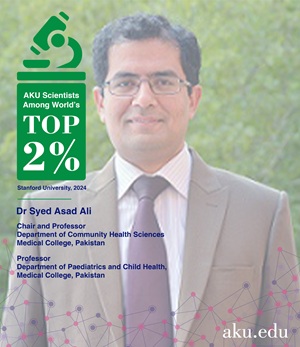 For Professor Syed Asad Ali, the journey began not in a gleaming lab, but with a profound, persistent question rooted in empathy: How can we leverage global scientific progress to improve the lives of people living in low-income settings? For more than two decades, this question has defined his career. Today, his contributions place him among Stanford University's list of the world's Top 2% most-cited scientists—a recognition that reflects not just academic excellence, but life-changing impact.
Dr Ali's work sits at the intersection of two of the most persistent challenges facing low-income countries: malnutrition and infectious diseases. In communities where poverty is a daily reality, these forces often collide with devastating consequences. His research has helped illuminate why malnourished children face exponentially higher risks from infections, how biological vulnerability and social disadvantage reinforce each other, and what interventions can meaningfully shift outcomes. His team's approach: melding cutting-edge biomedical tools with rigorous analysis of social determinants, has provided rare, contextually-grounded insights that global health agencies increasingly rely on.
As Chair and Professor of the Department of Community Health Sciences and Professor of Paediatrics and Child Health at the Aga Khan University, Dr Ali leads efforts that move beyond describing problems to designing solutions. His research programmes have shaped the understanding of childhood diarrhoea, vaccine-preventable diseases, environmental enteric dysfunction, and immune responses in malnourished children: areas that now guide public health strategies. His contributions to Pakistan's immunisation ecosystem are equally significant. As Chair of the National Committee monitoring adverse events following immunisation, he ensures vaccine safety systems meet global standards. His earlier role with the National Immunisation Technical Advisory Group helped strengthen policy decisions during critical periods of Pakistan's vaccination journey.
What sets Dr Ali apart is a scientific philosophy rooted in equity. He believes that children in Pakistan deserve the same evidence-based care as those in wealthy countries—and that research conducted locally is essential to achieving that standard. Supported by competitive grants from the Bill & Melinda Gates Foundation, the NIH, and the CDC, his work has amplified Pakistan's voice in global health research, ensuring that interventions designed elsewhere are informed by the lived realities of South Asian communities.
His leadership extends beyond laboratories and advisory boards. He has recently published a book, 'Poverty to Prosperity – A Blueprint for Change', in which he gives a fresh framework of public-entrepreneurial partnership as a means to address extreme poverty and its associated challenges in countries like Pakistan. He sees AKU's unique position—a world-class university operating in a developing country—as a responsibility and a strategic advantage. By strengthening research ecosystems, mentoring young scientists, and advocating for data-driven policy, he is helping build the next generation of health researchers who will define Pakistan's scientific future.
Behind the citations, awards, and global influence is a clear purpose: improving the lives of children who face the deepest vulnerabilities. Whether speaking to policymakers about vaccine access, training young clinicians, or analysing data from a remote community, Dr Ali's work remains grounded in the belief that science must serve society. His career is a testament to how one physician-scientist can reshape understanding, strengthen systems, and expand possibilities for millions of children who deserve a fair chance at life.