Dr Afia Zafar
Strengthening Pakistan's Front Line Against Infectious Disease
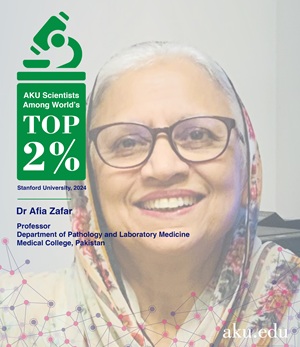 Professor Afia Zafar is a trained microbiologist whose work has had profound local and national impact. With more than 135 publications and major contributions to Pakistan's national Infection Prevention and Control and Tuberculosis Control Guidelines, her research is helping save lives in a country that carries a heavy burden of infectious and communicable diseases, including tuberculosis, hepatitis and HIV, alongside the growing threat of antimicrobial resistance.
Infection Prevention and Control has become an urgent priority in Pakistan, particularly in the post-COVID-19 era. In this context, the work of researchers like Dr Zafar is essential to protect health systems and save lives.
Dr Zafar currently serves as Professor and Consultant Microbiologist in the Department of Pathology and Laboratory Medicine at the Aga Khan University in Pakistan. Over more than two decades at AKU, she has held several key leadership roles, including Chairof the Department of Pathology and Laboratory Medicine and Chair of the Aga Khan University Hospital's Infection Control Committee.
At AKU, Professor Zafar has focused her research on infectious diseases, particularly infection control, antimicrobial resistance and fungal infections. These areas are critically important in Pakistan's public health landscape. Her work has been widely cited, with more than 2,800 citations, placing her among the world's top two per cent of most-cited scientists according to a research study conducted at Stanford University.
The significance of her research becomes clearer when viewed against Pakistan's disease burden. Tuberculosis alone causes around 47,000 deaths each year. Pakistan accounts for 73 per cent of the tuberculosis burden in the Eastern Mediterranean Region and ranks as the fifth most affected country globally. Antimicrobial-resistant infections represent a growing global crisis and in Pakistan are associated with more than 200,000 deaths annually. Fungal infections, often underdiagnosed, also pose a major public health challenge, highlighting the urgent need for improved research, diagnosis and treatment.
Reflecting on her journey at AKU, Dr Zafar speaks of how early exposure to research shaped her path. “In the very early days of my job, I got motivated and developed an interest in research. It is the environment of this Institution which provides us opportunity, it trains our mind and thoughts," she says. She credits AKU's academic leadership, seniors and peers for their role in her growth, noting that “the mentoring and guidance they provide take us to the highest levels."
Beyond research, Professor Zafar is also a highly regarded teacher with a strong commitment to advancing undergraduate and postgraduate education. Her contributions have been recognised with AKU's Outstanding Teacher Award in 2004 and the Mentor Teacher Award in 2022.
Her expertise has also benefited institutions beyond the University. Professor Zafar has worked to support the propagation and implementation of infection control practices in resource-limited settings, helping hospitals develop safer systems for patients and staff. Recent contributions include work with Kohi Goth Hospital - a charitable hospital in Landhi, Sindh, and Abbasi Shaheed Hospital, where she is supporting the supervision of infection control activities.
At the national and international levels, Professor Zafar continues to shape the field through her professional engagements. She is a member of the Pakistan Association of Pathologists, the Medical Microbiology and Infectious Diseases Society of Pakistan, the European Society of Clinical Microbiology and Infectious Diseases, and the Pakistan Medical Association.
Her career-long dedication has earned her multiple honours. Recent recognitions include the Lifetime Achievement Award (2025) from the Pakistan Association of Pathologists, and the Award of Excellence (2024) from the Medical Microbiology and Infectious Diseases Society of Pakistan. Her research has also been recognised by the International Federation of Infection Control Congress and the Eurasia Congress of Infectious Diseases.
Through research, leadership, teaching and service, Professor Afia Zafar's work continues to strengthen Pakistan's capacity to prevent and control infectious diseases, protecting lives today while building a safer, more resilient health system for the future.