Aga Khan University is set to collaborate with the globally recognised independent accreditation and academic standards body, the Higher Education Academy (HEA), as part of the University’s continuous efforts to ensure excellence in teaching and learning.
Under the agreement, the University’s Networks of Quality, Teaching and Learning (TL_net) will seek accreditation from the HEA, which supports over 86,000 fellows in 46 countries in their efforts to pursue the highest standards in teachin
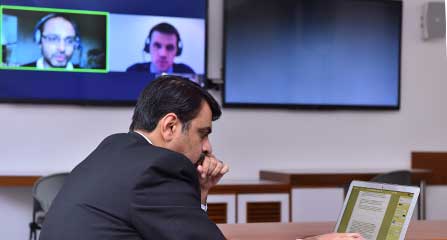
A participant at the workshop considers feedback on his fellowship application.
g in the higher education sector. The HEA maintains the UK Professional Standards Framework (PSF) – a comprehensive set of professional requirements and guidelines designed to help universities enhance teaching quality through individual or institutional staff development programmes.
The first phase of the partnership saw 12 AKU teaching staff in Karachi and Nairobi, who are already involved in mentoring teachers, participate in a one-day remote session led by the HEA’s Professional Practice team.
The session aimed to inform AKU teaching faculty of the requirements needed to become HEA fellows and the quality assurance standards contained under the PSF. The expertise shared at the session enabled faculty to gain the necessary expertise to become ‘early adopters’ who can then guide other faculty on how to foster the best educational practices and thereby gain recognition as Associate Fellows and Fellows of the HEA.
Dr Tashmin Khamis, Director, Aga Khan University Network of Teaching and Learning, said, "We place huge importance on teaching at AKU and this initiative is a key part of our strategy to sustain our reputation for academic excellence. I see the HEA fellowship as a great opportunity to reward and recognise staff for their commitment to teaching, and to encourage a culture of reflective practice and continuous professional development.”
"Teaching is a dynamic process, and HEA Fellowship, underpinned by the Professional Standards Framework, is a great way to support a mindset that's always looking to achieve more," Dr Khamis added.
Attendees at the workshop included AKU staff involved in faculty development, curriculum review and blended learning. A participant at the workshop, Faisal Ismail, assistant professor in the Department of Medicine, said:
“The fellowship requires you to comprehensively reflect on your teaching methods and to take a good look at the impact of your teaching and where you’d like to improve. This is one of the most rigorous processes I’ve undergone for professional recognition and achieving a fellowship will ensure that faculty are recognised for their commitment to effective teaching practice.”
Nick Fletcher, HEA’s International Development Manager, said, "We are very much looking forward to working with AKU and supporting their strategy for staff development. HEA Fellowship is internationally recognised, and the Professional Standards Framework is a robust vehicle at every career stage, from new-to-teaching to leadership roles in learning and teaching."
The TL_net is working to develop a culture of excellence in teaching at AKU. Besides regularly benchmarking academic programmes against international standards through programme reviews, it also runs regular workshops to enhance the skills of faculty. It aims to eventually develop a pool of teaching experts on campus who can regularly mentor faculty and to ensure that teaching standards are maintained across the University.