Under one per cent of Pakistani newborns are being screened for preventable genetic diseases which can lead to lifelong disability and even mental retardation, said experts at a conference to mark World Rare Disease Day organised by Aga Khan University.
Newborn screening for rare diseases such as congenital hypothyroidism, CHT, a disease that limits the production of hormones by the thyroid gland, is mandatory in China, Europe, the US, and Canada. However, only one private hospital and a single
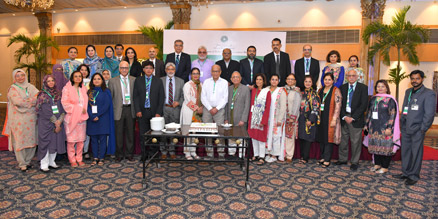
Members of the Pakistan Inherited Metabolic Disease Network pose for a group photo at the event organised by AKU.
charity organisation in Pakistan offer the test.
CHT, which has no visible symptoms, can impair a child’s brain development as early as the two-week mark. Newborn health screening would have picked up CHT at birth enabling the disease to be managed through a daily dose of a low cost, generic tablet, levothyroxine.
Experts noted that even though a Karachi-based private hospital has the technology to test for CHT and four other rare diseases (cystic fibrosis, congenital adrenal hyperplasia, biotinidase deficiency and galactosemia); it is rare for babies to be screened at birth in Pakistan even though such screening has been common in the developed world for the last 50 years.
The seminar brought together genetic researchers, pathologists and child health specialists from public and private sector organisations across the country to launch an advocacy group, the Pakistan Inherited Metabolic Disease Network (Pak-IMD-Net).
Led by the Pakistan Society of Chemical Pathology, the network seeks to address shortcomings in research, medical education and clinical practice related to inherited metabolic disorders and to encourage policy reforms to expand access to newborn screening.
Currently there are no national studies on the prevalence of rare genetic illnesses with data largely existing in silos within individual hospitals. “Greater sharing of data between organisations will help identify the most common genetic diseases, said Dr Aysha Habib, an associate professor in pathology and laboratory medicine at AKU.
Such collaborations will also enable analysis of deeper questions such as the vulnerability of particular ethnicities to rare illnesses and lead to insights into whether unique genetic mutations exist in the region, Dr Habib added.
“Technology and effective regulations in the West mean that a single blood test can screen a child for 50 genetic diseases,” said Dr Lena Jafri, an assistant professor at AKU and chair of Pak-IMD-Net. “By fostering partnerships with researchers and healthcare providers around the country, we hope to develop a consensus on a panel of screening tests that can provide maximum protection to newborns. We will then seek raise awareness for the need for these reforms with the provincial and federal health ministries to ensure that every newborn is screened.”
In the long-term, the organisation seeks to build capacity among child health professionals and to raise awareness among patients and health professionals about the importance of follow-up appointments and regular treatment to help each newborn lead a normal childhood.
Other speakers at the event included Dr Hussain Askree, a clinical biochemist and molecular geneticist at Genomics Lab, USA, Dr Jamal Raza, Director, National Institute of Child Health, as well as Dr Bushra Afroze and Dr Salman Kirmani from the department of paediatrics and child health at AKU.