The Aga Khan Award for Architecture held a seminar on ”Architecture is Life” in collaboration with the Aga Khan University today.
Architects, urban planners and academics from around the world gathered in Pakistan to discuss the latest Award recipients - projects that not only showcase architectural excellence but also improve the overall quality of life.
The Institute of Architects of Pakistan presented a citation to His Highness the Aga Khan, expressing their gratitude for his patronage of arch
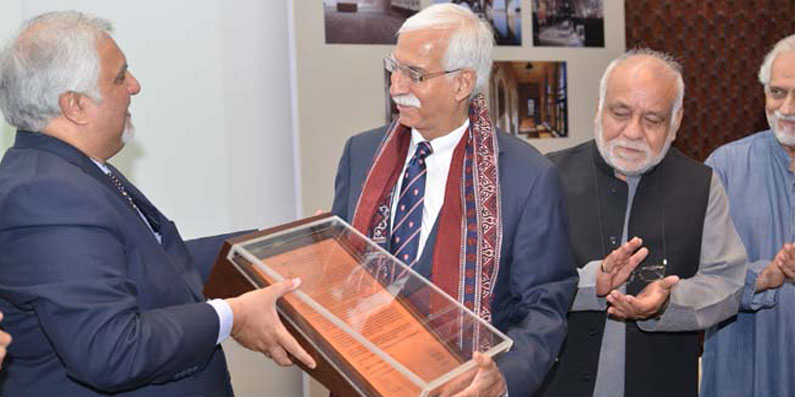
Firoz Rasul, President AKU, accepts a citation, on behalf of His Highness the Aga Khan, presented by the Institute of Architects of Pakistan
itecture particularly in Pakistan. The University’s President, Mr Firoz Rasul, accepted on his behalf.
The winners of the 2013 cycle encompass a bridge in Morocco, a hospital in the Sudan, the revitalisation of the centre of a historic old town in Palestine, a bazaar in Iran and an Islamic cemetery in Austria. These projects cover infrastructure improvement and urban planning, and rehabilitation of historic spaces that lead to the creation of employment and the revival of traditional crafts.
“AKAA is one of the most prestigious international architectural awards in the world. The US$ 1 million award recompenses all the actors involved in the achievement of excellence, whether they are architects, clients, craftsmen, engineers or end-users,” said Farrokh Derakhshani, Director, AKAA.
Many in Pakistan have contributed to the Award procedures during the last twelve cycles. Four local projects are among the 110 recipients so far. In 1983, the Tomb of Shah Rukn-i ‘Alam in Multan was recognised for its conservation and restoration, and the populist Bhong Mosque in Rahim Yar Khan was cited for its folk-art exuberance and its service to the community. The Khuda ki Basti project in Hyderabad was selected in 1995 for its exemplary incremental development for low-income inhabitants. The Alhamra Arts Council complex in Lahore was awarded in 1998 for its contemporary architectural design.
“The very first Aga Khan Award for Architecture was presented in 1980 at the Shalimar Gardens in Lahore. It was an event whose importance was recognised by the Government of Pakistan, which issued a stamp featuring the gardens,” recalled Hasan-Uddin Khan, convenor of the first cycle of the award and distinguished professor of Architecture and Historic Preservation, Roger Williams University, USA.
He stressed that Pakistan plays an important part in the story of the Award: it was here in the mid-1970s that His Highness the Aga Khan announced his plan to establish an award for architecture that would recognise and reward the outstanding creative achievements of individuals, communities, and institutions that contribute to the elevation of the quality of architecture and life in contemporary Muslim societies.
“AKAA introduced the notion that in the judgment of successful architecture, one needs to consider it as the production of a group of people, which includes the client, architects, the builders, craftspeople and the users themselves. This was an idea that was largely absent from the architectural discourse when the Award was first established. This is an enduring contribution to architecture and the way in which it is mediated,” he added.
The exhibition Architecture is Life presents the 20 projects, located in 15 different countries, which were shortlisted during the 2011-2013 Award cycle. It will open to the public from November 9 to 16, from 11:00 am till 7:00 pm, at the AKU Sports and Rehabilitation Centre.