Workshop on AI-Powered Research Tools
Event: Pre-Conference Workshop, 4th International Nursing Research Conference (NRCON2025)
Topic: From Search to Publication: AI-Powered Research Tools in Health Sciences
Dates: November 21, 2025 & November 24, 2025
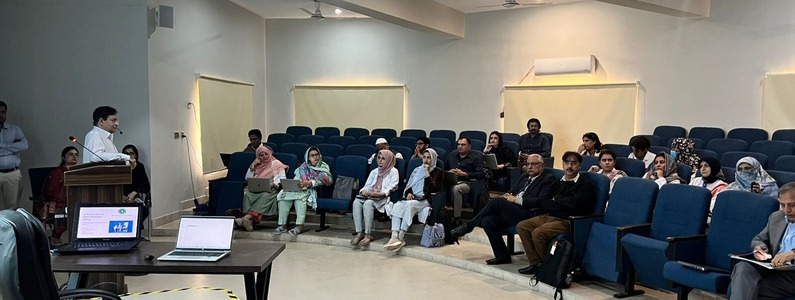
The pre-conference workshops titled "From Search to Publication: AI-Powered Research Tools in Health Sciences" were successfully conducted across two sessions on November 21 and November 24, 2025. These sessions were organized by Prof. Dr. Ilyas Siddiqui and Dr. Rafaina Shah as a key component of the 4th International Nursing Research Conference (NRCON2025). The first session was hosted by Ms. Perveen Akhtar, Director of People’s Nursing School, LUMHS Jamshoro, while the second session was hosted by Prof. Dr. Ghulam Sarwar Qureshi, Principal of LUMHS International Medical and Technical College, Thatta. The workshops attracted a total of approximately 60 participants, comprising nursing students, master’s candidates in public health, and faculty members from Thatta Medical College. Facilitated by Dr. Sheraz Ahmed, Assistant Professor at Aga Khan University, with co-facilitation by Dr. Fayaz Umrani and Mr. Abdul Khalique Qureshi, the primary objective was to equip emerging health researchers and junior faculty members with practical skills to integrate artificial intelligence responsibly into their research workflows.
Each two-hour intensive session was structured to guide participants through the entire research lifecycle, from initial inquiry to final manuscript submission. The facilitators adopted an interactive, hands-on pedagogical approach, beginning with the fundamentals of prompt engineering to ensure participants could effectively communicate with advanced language models. Subsequent modules focused on leveraging AI tools for efficient literature discovery using platforms like Consensus and Semantic Scholar, followed by practical demonstrations of AI-assisted academic writing and editing. A significant portion of the workshop was dedicated to data analysis and visualization, demystifying complex statistical processes for students. Crucially, the session placed a strong emphasis on ethical considerations, with dedicated discussions on data privacy, the prevention of plagiarism, and the critical importance of human oversight in AI-generated content.
The outcomes of the workshops were highly positive, with participants demonstrating a marked increase in confidence regarding the use of digital research tools. Feedback indicated that the attendees particularly valued the practical exercises and the clear, actionable guidance on avoiding common pitfalls such as "AI hallucinations" and data privacy breaches. By the conclusion of the sessions, students and faculty had acquired a toolkit of resources to accelerate their literature reviews, refine their academic writing, and manage references more effectively. The workshops successfully achieved their goal of bridging the gap between traditional nursing research methods and modern technological advancements, empowering the next generation of health professionals to conduct high-quality, efficient, and ethically sound research.